


The CMA has published further guidance for businesses on how UK consumer protection laws apply to environmental claims in a supply chain context (the “Supply Chain Guidance”). This is the latest in a series of CMA guidance on the topic of environmental claims and responds to stakeholders’ calls for greater clarity on the allocation of responsibility for such claims between supply chain members.
Key takeaways from the Supply Chain Guidance
The Supply Chain Guidance does not move the dial on the CMA’s established approach to assessing whether environmental claims are misleading (see the Green Claims Code and our blogs on recent guidance here and here), but offers a more nuanced picture of which parties in the supply chain may be held responsible for such claims (see Illustrative Examples below).
Illustrative Examples
The “Illustrative Examples” in the Supply Chain Guidance provide businesses with some helpful insight into where the CMA might focus its enforcement resources when tackling misleading environmental claims in certain scenarios:
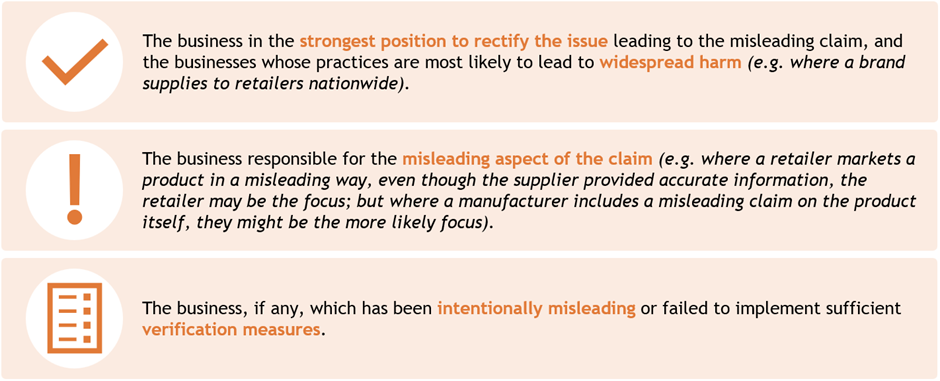
These indications are helpful, however, the Supply Chain Guidance makes clear that businesses throughout the supply chain have responsibility for taking:
“steps to ensure that any environmental claims they make (whether directly, indirectly or by passing information from others on to consumers) are accurate and not misleading.”
It is also clear through the CMA’s Illustrative Examples that multiple parties can be held responsible for a misleading environmental claim. This makes meaningful engagement with supply chain partners essential for businesses, to minimise the risk of regulatory challenge.
Checklists for supply chain partners
The Supply Chain Guidance includes checklists with suggestions for retailers, brands and suppliers and manufacturers when making environmental claims. In summary, these recommend that:
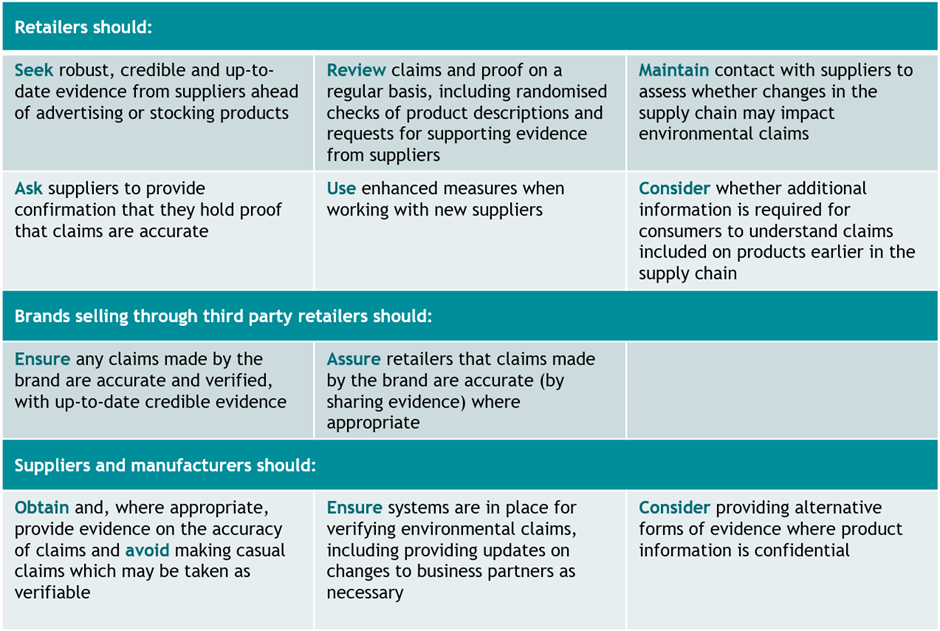
What does the Supply Chain Guidance mean for businesses in practice?
The checklists provide a helpful starting point for the practical steps that businesses can take to comply with the Supply Chain Guidance. However, satisfying the checklist will not guarantee protection from regulatory scrutiny, so many businesses will be looking for greater protection from the risk of the CMA’s new enforcement and fining powers (see here).
The Supply Chain Guidance recommends that businesses work together to ensure that claims made to consumers are accurate and not misleading. In practice, businesses will need to consider the maturity of their supply chains and their wider regulatory context as part of their compliance efforts.
A. Supply chain maturity: contracting and supplier relationships
- Developing effective contracting frameworks: businesses should review how supplier contracts and codes of conduct interact, and ensure that their information/audit rights entitle them to sufficient information in appropriate timeframes (including to respond to regulatory queries). Contracting processes should feed into wider governance and due diligence frameworks.
Building trusting supplier relationships: as detailed in the CMA’s Illustrative Examples, businesses may find themselves exposed to regulatory scrutiny (and potentially responsible) even where a supplier has not passed on relevant information.
In addition to ongoing, regular due diligence of environmental claims, downstream businesses should consider how to strengthen business relationships to encourage transparency from suppliers. Options to consider might include longer-term contracts, capacity building and supplier training, especially where the bargaining power of business partners is uneven.
- Implementing sophisticated approaches to supplier due diligence: the mere existence of supplier due diligence alone is not necessarily enough to insulate businesses from risk; businesses need to appraise its practical effectiveness and adjust as necessary. Integrating due diligence processes (for example, regular confirmations regarding sub-contracting and other key information) into existing operational touchpoints with suppliers may help lighten the load.
B. Wider regulatory landscape
When implementing the Supply Chain Guidance, businesses must consider other applicable regulatory regimes and guidance, for example when requiring information from suppliers or considering withdrawal from trading relationships.
- Proposed amendments to the Corporate Sustainability Due Diligence Directive (“CS3D”) and Corporate Sustainability Reporting Directive (“CSRD”) set guardrails on the detail and type of information which can be requested from small businesses. If the amendments are approved by the European Council (expected in early 2026), under the CS3D information requests could only be made of smaller companies “when the information cannot reasonably be obtained by other means”, and the CSRD would permit smaller companies to use estimates in place of some information that is difficult to gather. See our blog for more detail.
- Similarly, the Supply Chain Guidance notes that, if its business partner cannot or will not verify an environmental claim, a business may need to reconsider its trading relationship with that partner. In such cases, businesses will need to consider any commitments to international principles (such as the OECD Guidelines for Multinational Enterprises on Responsible Business Conduct) requiring them to comply with principles of responsible disengagement, some which are also reflected in the revised draft of the CS3D. Businesses should also be mindful of the application of local laws applying to withdrawal, especially in the context of international retail supply chains.
C. Further recommendations
For further recommendations based on the CMA’s wider green claims guidance, see our blog on the CMA’s guidance for the fashion retail sector or get in touch with your Slaughter and May contact.

/Passle/620e2412f636e9042828e117/SearchServiceImages/2026-10-19-15-48-57-205-6ad63be9842f4c8f57f73b5c.jpg)
/Passle/620e2412f636e9042828e117/SearchServiceImages/2026-10-16-08-57-48-256-6ad1e70caa6596dee34c175c.jpg)
/Passle/620e2412f636e9042828e117/SearchServiceImages/2026-10-15-13-54-00-458-6ad0daf8d13e4bbdf6a78376.jpg)
/Passle/620e2412f636e9042828e117/SearchServiceImages/2026-10-08-08-19-22-494-6ac7520ace624e48d6cca211.jpg)